Thursday, August 23, 2012

SIREH UNTUK KELUARKAN ANGIN

Berikut adalah cara tradisional untukmengeluarkan angin daripada perut bayi:

  1. Dapatkan 2 atau 3 helai daun sirih dari Kedai India atau pasar.
  2. Kemudian layur daun sirih pada api.
  3. Daun yang panas dilekapkan pada bahagian pusat bayi.
  4. Kemudian daun itu dilekapkan pada bahagain belakang perut bayi.
  5. Akhir sekali, pakaikan barut perut.

Wednesday, August 22, 2012

BOUGAINVILLEA PLANTS THRIVE ON SUNSHINE


The weather nowadays is sunny and hot, except for the occasional rain. That is why the bougainvillea plants everywhere are blooming profusely. They are indeed a beautiful sight to behold. I am sharing with you a plant that I spotted while I was back in Ipoh. This plant had red and white flowers.

VERSI BAHASA MELAYU
Cuaca sekarang panas terik.  Itulah sebab pokok bunga kertas berbunga dengan lebat di merata-rata tempat.  Memang cantik dipandang.  Gambar-gambar pokok bunga kertas yang berbunga putih dan merah tumbuh di kawasan perumahan saya di Ipoh.

POKOK NAM NAM


3 gambar di atas menunjukkan pokok nam nam yang ditanam di Taman Herba Kolej Vokasional Seri Manjung. Usia pokok ini tak sampai 2 tahun dan saya perlu masa lama lagi untuk dapat menikmati buahnya. Pokok nam nam atau nama saintifiknya Cynometra Cauliflora merupakan tumbuhan unik kerana berbunga dan berbuah di batang. Saya membaca satu artikel di laman web yang mengatakan pokok Nam Nam digunakan untuk penyakit darah tinggi dan boleh kuruskan badan. Bagaimana? Senang sahaja. Hanya rebus daunnya sehingga warnanya seperti air teh dan minum. Rasanya seperti air masak biasa. Buahnya boleh di makan begitu sahaja tanpa di buang kulit.
Rasa buah nya kelat masam masam manis

Berikut adalah satu artikel mengenai Nam Nam yang diambil dari Sinar Harian

Nam nam dipanggil buah katak puru
Oleh : Wartawan Sinar Harian
Tarikh : October 26, 2011


Buah katak puru? Kenapa namanya begitu? Begitulah gelaran yang dipanggil kepada buah nam-nam kerana mempunyai kulit luaran yang kurang menarik dan menggerutu.

Walaupun nama dan bentuk luarannya tidak secantik buah-buahan yang lain, namun bagi mereka yang biasa merasai buah ini tentu membuatkan air liur terasa kecur.

Buah ini memang sedap dicicah dengan sambal kicap, garam atau kuah rojak. Ada juga yang membuat sambal ikan dengan menumbuk ikan dan cili bersama-sama buah katak puru.

Memang sedap jika dimakan bersama nasi yang masih panas. Malah, bukan itu sahaja, buah yang kaya dengan vitamin C ini juga boleh dijadikan jus.

Buah nam nam yang bersaiz di antara lima hingga enam sentimeter (cm) ini mempunyai rasa masam kelat ketika muda dan akan berubah menjadi masam manis apabila masak.

Bijinya pula berbentuk leper. Selain dimakan segar, daun dan buah nam nam juga mempunyai khasiat perubatan.

Kebanyakan orang-orang terdahulu mempercayai dengan memakan buah dan pucuk pokok ini dapat mengubati penyakit darah tinggi dan kencing manis.

Ada juga yang menjadikannya ramuan dalam ubat bagi merawat batu karang. Selain itu, daunnya juga boleh dikeringkan dan dijadikan seperti minuman teh.

Pokok nam nam atau nama saintifiknya Cynometra Cauliflora merupakan tumbuhan unik kerana berbunga dan berbuah di batang.

Pokok yang dikatakan berasal dari Borneo ini mempunyai ketinggian di antara tiga hingga enam meter (m) sahaja.

Pokok ini masih lagi ditemui di Semenanjung Malaysia terutama di kawasan Utara dan Pantai Timur. Pokoknya mudah tumbuh melalui kaedah tanaman biji ataupun tut.

Ia memerlukan kawasan yang bersaliran baik dengan sinaran matahari yang cukup untuk tumbuh subur.

TIME TO TEND TO THE HERB GARDEN


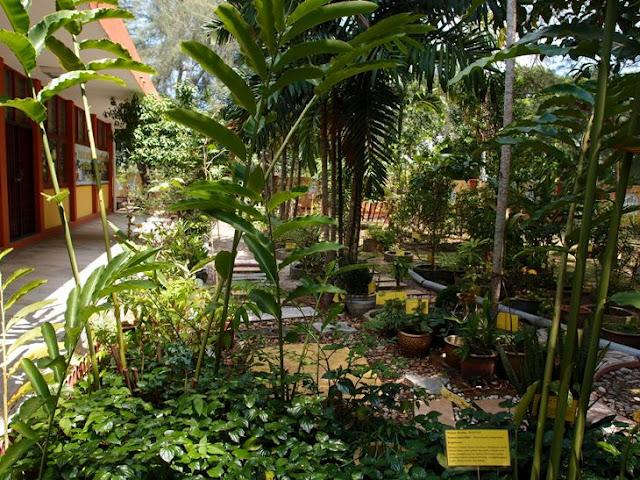
During school days I am busy teaching my students and also doing administration work for the library which leaves me little time to tend to the Herb Garden. Luckily, it is school holidays now and with the students not around, I have time to check the plants in the Herb Garden and do some pruning.  Also, I have time to do some posts for this blog which I have been neglecting for months.

POTPOURRI FROM SCENTED LEAVES


I picked some scented leaves from the Herb Garden, cut them in thin slices to release the fragrance and made them into potpourri. The scented leaves that I used were lemon, kaffir lime (limau purut), pandanus and cinnamon. I love the leaves fresh instead of dried. Natural scents can enhance and add natural, fresh fragrance to my home.

PAGODA FLOWER (PEPANGGIL)


This herb is used to stimulate the body to produce blood and stabilize the demand / volumeof red blood thus preventing the occurrence of disease in the body. thus, one would not have anemia.

Ingredient
pagoda flower root dry

Usage:

Boil pagoda flower root dry in 4 cups of water to the remaining 2 cups of water. Once cool, filtered water and drink 2 times a day 1 cup each of brackish.


SOURCE: http://tmedical.blogspot.com/2012_02_01_archive.html

GRASS PEARLS (HEDYOTIS CORYMBOSA)


When I was much younger I used to help my godmother look for herbs that grow wild in many places. She'd used them to make Medicated Oil or Minyak Angin. While looking for the herbs that she needed, she'd also point out to me other herbs that have medicinal uses. Of these is the Grass Pearls.
The plant shown in the picture is growing healthily in my garden. Grass Pearls or Hedyotis corymbosa are shrubs that grow wild in many places. Many people regard them as weeds and just pull them out.

Let me share with you information about Hedyotis corymbosa. Read on ...

Hedyotis corymbosa useful to relieve the heat, anti-inflammation, urinary shed, remove heat and toxin as well as activate blood circulation. Diseases associated with respiratorytract such as tonsillitis, laryngitis, bronchitis, pneumonia can be treated with this plant.Similarly, other diseases such as hepatitis, pelvic inflammatory disease and urinary tract infections.

Benefits:
1. Cope with respiratory distress
2. Maintaining healthy liver function
3. As an anti inflammatory like amanadel inflammation, sore throat, and pelvic inflammatory disease
4. Activate blood circulation
5. Treating urinary tract infections
6. Remove heat and toxin
7. Treating hepatitis


SOURCE: http://tmedical.blogspot.com/2012/02/hedyotis-corymbosa-grass-pearls.html

KESOM


I was walking out from bank after withdrawing some money from the ATM when I saw this healthy looking Kesom Plant or Laksa Leaf growing in front of the premise. Someone must have planted it there intentionally as I noticed water dripping down from the air conditioning unit from the second floor. For your information, planting this herb is very simple indeed. All you need to do is to get a few stalks of fresh daun kesum from the wet market and just stick them into damp earth and you will have them growing in no time.The scientific name of this herb is Persicaria odorata. It is also known as Vietnamese coriander. Here in Malaysia, daun kesom is one of the ingredients used to make Laksa.
I found an interesting fact about daun kesom. It seems that it is used traditionally in Vietnam to repress sexual urges. There is a saying in Vietnamese, "rau răm, giá sống" ("Vietnamese coriander, raw bean sprouts") meaning that Vietnamese coriander has the ability to reduce sexual desires, while bean sprouts have the opposite effect. Many Buddhist monks grow coriander in their private gardens and eat it frequently as a helpful step in their celibate life.
LINK

VERSI BAHASA MELAYU
Saya terjumpa pokok kesom tumbuh subur di tempat yang disediakan untuk tanaman hiasan di luar satu bank. Saya agak pokok ini ditanam oleh seorang kerana ianya ditanam dibawah satu unit penghawa dingin.  Air dari penghawa dingin akan memastikan tanah sentiasa basah.  Sebenarnya menanam daun kesom sangat mudah.  Hanya perlu dapatkan beberapa batang daun kesom dari pasar dan cucuk dalam tanah basah.  
Nama saintifik untuk Keosm adalah Persicaria odorata.  Ia juga dikenali sebagai Vietnamese coriander.  Di Malaysia, daun kesom merupakan salah satu bahan untuk membuat laksa.
Di negara Vietnam, daun kesom digunakan untuk menahan keinginan seks.  Ramai sami Buddha menanam pokok ini di kebun dan makannya supaya dapat mengamalkan kehidupan tanpa seks.

Tuesday, August 21, 2012

FRESH DATES


During the Ramadan month, I got to see lots of dried dates being sold at the supermarkets as the Muslims eat this energy boosting fruit for sahur and also for breaking fast.
I also saw fresh dates for sale but then they were not that easily available as the dried ones. The fresh dates that are pictured above appear to be soft or semi-soft. So what is the difference between a fresh date and a dried one. A dry date simply contains less moisture than a soft date. Fresh dates, if kept in an airtight container, stay fresh for up to 8 months if kept refrigerated, or for up to year in the freezer. A dried date is deliberately dehydrated to remove its moisture. Dried dates have a longer shelf-life than the fresh. Dried dates if refrigerated in an airtight container stay fresh for up to one year, and if in the freezer can last up to five years.
Read more: http://www.livestrong.com/article/527815-fresh-dates-vs-dried-dates/#ixzz23RUbyQKJ

NATURAL AIR FRESHENER

I had to attend to a call of nature when I was eating out at a cafe recently. What caught my attention was the bowl of orange peels in the loo. I guess it is a natural air freshener. So, don't throw away your orange peels. There is use for them.

VERSI BAHASA MELAYU
Semasa di Bilik Air sesuatu cafe, saya nampak kulit kupasan oren digunakan sebagai air freshener.  Oleh sebab itu, jangan buang kulit oren, simpan untuk digunakan sebagai air freshener.

Friday, July 20, 2012

COFFIN TREE


Here is a tree I saw at the Gaharu Tea Valley. According to the guide, the wood of the tree is used to make coffins. Anyone knows the scientific name of this plant?

I saw this species of tree once again when I was at the Riverfront Hotel. They were planted outside the hotel. You can see it below.


AKAR DANI (Quisqualis indica)


Bunga Akar Dani (Nama botaninya Quisqualis indica, dengan nama genusnya Quisqualisnga) yang berbunga kecil dan lebat (kiri), dan yang berbunga besar tapi biasanya kurang lebat (kanan).

Pokok Akar Dani juga dijadikan bahan perubatan tradisional. Rebusan akar, biji atau buahnya boleh dipergunakan sebagai antihelmintik serta juga untuk mengurangkan cirit-birit. Rebusan buahnya juga boleh digunakan untuk merawat nefritis serta juga sebagai ubat kumur, manakala daunnya boleh digunakan untuk mengurangkan sakit yang diakibatkan oleh demam. Akarnya digunakan untuk merawat reumatisme (sengal-sengal tulang), manakala biji dari lenggainya digunakan untuk merawat cacing bulat dan cacing peniti kerana ia boleh meracuni parasit tersebut dan membunuhnya semasa di dalam saluran penghadaman.
(Sumber: Wikipedia BM).
LINK: http://www.facebook.com/RoslanZainalalAhmadi

Thursday, April 12, 2012

JARUM TUJUH BINTANG


I haven't been indulging much in my hobby of hunting for plants as I have been busy with work. However, I happened to chance upon the Rose Cactus (Pereskia Grandiflora) or Jarum Tujuh Bilah when I went to buy dumplings from the shop selling Angry Bird Buns. The plant was growing by the roadside and I managed to snip a few branches back to plant in the Herb Garden. Now the number of species of plants in the herb garden has increased to 122.
The leaves of the Rose Cactus are edible and it is used as a medicinal plant to treat cancer related illnesses. By the way, there is another species of this plant with orange flowers and goes by the scientific name Pereskia sacharosa/saecnarosa.

PADDY FIELDS OF TANJUNG KARANG

Below I am sharing with you pictures of the beautiful paddy fields at Tanjung Karang which were taken by my friend's brother. My friend, Puan Kamariah and her siblings grew up in such an idyllic village. Imagine the lush greenery, the fresh air and the beautiful scenery. Such healthy living!
For your information, Tanjung Karang is a paddy growing area.